




Armenian Orbeli Center interview with Georgian Expert Dr. Paata Tsagareishvili
source: https://orbeli.am/en/post/1473/2025-09-26
Dr. Paata Tsagareishvili is an expert of transport issues, Director of Transport Corridor Research Center based in Tbilisi, Georgia
– Mr. Paata, in recent years Georgia has undertaken large-scale infrastructure renovation and construction projects. Perhaps the most unprecedented among them is the Kvesheti–Kobi section of the North–South Corridor. In a recent interview with Orbeli, the Ambassador of Georgia to Armenia mentioned that it is planned to be put into operation in 2026. What makes this project unique, and what advantages will it bring to Georgia?
– Naturally, at this stage, when the Kvesheti-Kobi section is practically in the completion phase, making any revisions regarding this project is counterproductive. Despite this, it should be noted that from the very beginning, the Georgian political leadership made a “big” mistake, both political and economic, the long-term consequences of which are difficult to predict.
In a situation where the world is closing off transport arteries to Russia through various sanctions, Georgia has become a so-called “lifeline” for Russia. Our organization conducted a complex analysis of truck transport and basically revealed that Georgia’s cargo flow to Russia does not exceed 1.5 – 2 million tons per year. Such an insignificant cargo flow for the country did not require such large-scale investments in the Kvesheti-Kobi project.
Therefore, the question arises, why should Georgia take on a $1.2 billion debt from various financial institutions and build the Kvesheti-Kobi project with low financial costs for it? When the donor funds spent on the construction of the tunnel were freely sufficient to be directed to other priority projects for Georgia. I will name only two projects that are essential for the survival of the transport corridor passing through Georgia – Construction of Anaklia Port and access railway and road networks and renewal of the locomotive fleet for Georgian Railways.
For your information, the number of locomotives over 35 years old on Georgian Railways exceeds 65%. Why should we go to a country like China to seek funding for priority projects? Where, if the money is not paid, Georgia could find itself in a state of bondage. In the situation when Russia saw Georgia’s so-called capitulational position, it quickly restored the Upper Larsi customs and increased it from 4 to 13 freight lanes.
No, and we don’t need to strain our memory to recall how Russia halted the export of Georgian wine 15 years ago, based on political motives. By the way, the Russian ban at that time had a positive result for Georgia – Georgian wine found its way to European markets. No matter how far we go, there are many examples that can be given, even in relation to Armenia, how Russia stopped the export of cognac. A few years ago, after a political statement by Estonia, the export of Estonian sprat to Russia was felt. In conclusion, Georgia’s change of political vector and cooperation with Russia may lead to difficult and irreparable political and economic consequences in the long term.

– Another major project is the construction of two sections of the East–West Highway. With financing from the European Bank, these sections of the East–West Highway were planned to extend to the borders with Armenia and Azerbaijan. At what stage are these construction works, and how significant will they be in developing Georgia’s economic relations with neighboring countries?
– It is absolutely essential for Georgia to complete the construction of the East-West highway, I repeat, it is absolutely essential. I would like to give a few figures, the length of the East-West highway is 430 km, and 310 km have been completed to date, which is 72%. Construction began in 2007 and, according to the state’s promise, was to be fully completed in 2020. Since then, the completion deadline has been postponed six times and was supposed to be completed in 2025.
But recently, the Minister of Infrastructure set the completion date for the highway as 2032, so in the face of such “turbulent” promises, it is difficult to talk about any stages and, naturally, a specific completion date. The pace of highway construction in Georgia is low, up to 15 km per year. For comparison, the pace of construction of the Ashgabat-Turkmenabad highway in Turkmenistan, which is being built with donor funds, is almost five times higher and amounts to 60-70 km per year. Naturally, there are problems in managing financially viable infrastructure projects in the road sector.
– Recently, Georgian media has also been actively discussing the construction of a deep-sea portin Anaklia. What is the importance of Anaklia for Georgia’s infrastructure development in the context of broader regional dynamics?
– The issue is complex, so I’ll start from a little further back. The two main ports of Georgia, Poti and Batumi, were built during the Soviet period and were adapted to handle the cargo that the Soviet “planned” economy decided to handle. Today, the reality has changed dramatically, new types of cargo are emerging in Central Asia, requiring modern, adapted port infrastructure.
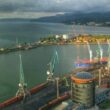
To make my point clearer, the era of “scrap” is over, but for example, scrap metal cranes are still in the Batumi port today. Existing ports, in the area they are in today, do not have the capacity to expand further, or their expansion and dynamic development is, to put it simply, uneconomical.
It is also important to consider that the cargo flow from Asia to Europe via Georgia is seven times greater than the cargo flow from Europe to Asia, and the reverse flow is practically small. This example is enough to conclude that European cargo owners are prioritizing the construction of a new deep-sea port.
Anaklia not only has the prospect of a deep-sea port, but the city of Anaklia City should be built behind it and English maritime law should be introduced. Anaklia City will be a new city in the Samegrelo region where work will be not only attractive but also prestigious for the Abkhazian population living just 10 kilometers away. In conclusion – Anaklia will not only function as a transport hub, but in the long term will turn into a port for the two fraternal Georgian and Abkhazian nations.
– Continuing on the Anaklia topic, let’s turn to the issue of investments. According to media reports, the Chinese-Singaporean consortium China Communications Construction Company Limited & China Harbour Investment Pte. Ltd. has expressed interest in investing in the port’s development.
However, the Georgian opposition claims that no formal agreement has yet been signed with any company. Reports suggest that by the summer of 2025, an agreement was expected under which the state would hold 51% of shares and the private investor 49%. How are developments progressing in the investment field, and what role has the government assumed in bringing the Anaklia Port project to life?
– The financing of the Anaklia project from the Chinese side is practically at a standstill or close to a standstill. I’ll start by describing the problem from a little distance, what drives Chinese companies to enter Georgia? A significant portion of the largest infrastructure projects in Georgia are being completed by Chinese construction companies. The reason for this is that they have submitted the lowest price in the multi – million dollar tenders announced by international donors. As a result, Chinese state-owned companies are building projects in Georgia supported by the World Bank, ADB, EIB, EBRD, and other international financial organizations.
In recent years, 6 Chinese construction companies have emerged in the railway and highway sectors, with a total contract volume of 2.5 – 3.0 billion dollars.
There are many examples in many countries around the world of how China is taking over and subsequently taking over transport infrastructure.
One of the common and widely tested models that China uses to seize a country’s infrastructure. It is based on lending its own funds through Chinese banks for the construction of an infrastructure facility and, in parallel, the construction of the same infrastructure facility by a Chinese company.
In fact, if this model is implemented, the risk increases that if the state where the transport facility is being built fails to repay the loan from the Chinese bank, China will immediately launch a strategy to seize this facility.
Ultimately, such a state will, after a certain period of time, feel the negative impact of the Chinese “debt trap”.
Georgia is accepting the “softened” model of road construction that China is applying to this or that country in a situation where this or that country borrows from various financial institutions around the world, China participates in the tender and enters the construction of only a transportation facility by offering a low construction price.
Such a model is associated with fewer risks for Georgia, if you do not include corrupt deals with local Georgian subcontractors, poor-quality construction, and environmental aspects.
As of today, the state’s final decision regarding the financing of the Anaklia port is known to have proposed a Chinese company to fill the 49% stake. While the 51% package remains in the hands of the state, we assume that in the absence of state funding, another possible scenario will be given to the development of the project.
Under the circumstances, if the state cannot ensure the accumulation of its own 51% of financial resources, what possible model will we be dealing with?
The financial contribution from the state to the Anaklia port, taking into account the access railway and roads, is 800 million dollars (rough estimate). How should the state ensure the attraction of this money?
The most attractive option is to take out a bank loan from China, which is the same as what we mentioned above, that Georgia is choosing the “loan lock” model, and there is a high probability that this option will be played out in Georgia as well.
Not all states take on debt from China, but those that bring China in as a partner face a dilemma: the state must cover the other half of the project’s participation itself, which is unlikely to happen over time.
Therefore, most countries turn to the Chinese government for loans. In the end, it all comes down to loans, and loans with unacceptable conditions.
The interest rate on the Chinese loan is high, and the terms are short. In case of non-repayment of the loan, China proposes to acquire a “controlling” stake in the constructed facility in exchange for a loan deferral. It is worth noting that the Chinese state-owned company China Communications Construction Company Limited CCCC, selected by the state to build the Anaklia port, has been subject to restrictions imposed by the US. He is included in the Consolidated Sanctions List (Non-SDN) by the US Treasury’s Office of Foreign Assets Control (OFAC), and has been exposed for corrupt activities in various countries.
– The developments around Anaklia are also being closely followed by major international players. What reactions have there been from Russia and the West on this matter? And what is the extent of China’s interest, given that Chinese companies are already actively involved in infrastructure development projects in Georgia?
– I answered a previous question about the involvement of Chinese companies in infrastructure projects in Georgia. So, after sanctions were imposed against Russia, and it is not yet known what kind of sanctions will be added, Russia will try to indirectly and actively engage in the management of Georgia’s infrastructure with the help of China.
Over the past 10 years, China has owned up to 100 major ports or terminals in 50 countries on every continent of the world. China has docks in various countries for shipbuilding. China owns about 20 major ports in Europe. It has the most powerful merchant marine fleet of 1300 ships. According to the presented scheme, China does not have port capacities in either Russia or America.
In what cases is Anaklia port attractive for Chinese cargo? The answer is unequivocal – in the only case – under the conditions of sanctions against Russian ports, Anaklia port will fulfill its the so-called “distribution” hub will function, where cargo will be delivered from China in large batches by ocean-going ships, and then distributed in small batches to 13 existing ports in Russia’s Black and Azov Seas. Naturally, this opinion has viability.
– What is Georgia’s approach regarding the potential operation of the “Persian Gulf–Black Sea” corridor? Is the launch of this corridor among Georgia’s strategic priorities?
In order for the “Persian Gulf-Black Sea” project to actually be implemented, it is necessary to overcome a number of infrastructural problems, which will require billions in investments. Therefore, at this stage, it is too early to talk about the attractiveness of this project.
– In your view, what is missing for the development of Armenia Georgia economic and infrastructure cooperation? Do the two countries have sufficient potential to significantly boost their current level of economic partnership?
As for infrastructure cooperation between Georgia and Armenia, I will return to the information on railway transportation. In recent years, the cargo turnover from Georgia to Armenia by rail has been stable and amounts to 0.7 – 0.8 million tons. Compared to 2012, when the “peak” volume was 1.38 million tons, and if we consider it as a baseline, the 2023 figure of 0.72 million tons indicates a 48% decrease from Georgia to Armenia. Such a decline in cargo flow from Georgia to Armenia requires additional research. Why can’t we return to the Gyumri dry port project, which was supposed to be operational in 2025. The success of this project will depend solely on geopolitics.


